

Pomskies | Who are they?
The Pomsky is a relatively recent addition to the canine world, capturing attention with its striking resemblance to a miniature wolf. By combining the genetics of two distinct Spitz breeds, the Pomsky bridges the gap between a working dog and a toy companion.

"Internet first bred Pomskies and they went viral"
01
History & Origins
Unlike ancient breeds with deep lineages, the Pomsky started as an internet myth around 2011. Viral photos of "miniature huskies" (which were actually Finnish Lapphunds or Alaskan Klee Kais) sparked massive demand for a dog that didn't yet exist. Breeders stepped up to turn the viral concept into reality, producing the first intentional Pomeranian-Siberian Husky crosses shortly after.
02
The Breeding Process
Because of the massive size difference between a Siberian Husky and a Pomeranian, natural breeding is unsafe. Pomskies are almost exclusively bred via artificial insemination. For the safety of the mother and the puppies, the mother is always a Siberian Husky and the father is always a Pomeranian.

"Breeding Pomskies is done by professionals"

"Pomskies often look like small huskies"
03
Physical Qualities
A Pomsky's appearance is a genetic lottery, though they generally look like a Husky that has been shrunk down to a plush, compact size. They typically weigh between 7kgs to 14kgs. They often inherit the Husky's striking facial masks, almond-shaped eyes (frequently bright blue or hetero-chromatic), and upright ears, all wrapped in a dense, fluffy coat.
04
Temperament
Pomskies are big personalities in small bodies. They inherit a potent mix of the Husky's vocal, pack-oriented goofiness and the Pomeranian's confident, sometimes sassy, loyalty. They are highly intelligent but can be stubborn, often "talking back" with a hilarious array of howls, grumbles, and yips. They bond intensely with their families and make excellent watchdogs. They are rather playful than boring, rather clinging than independent.

"Pomskies are playful and hilarious"
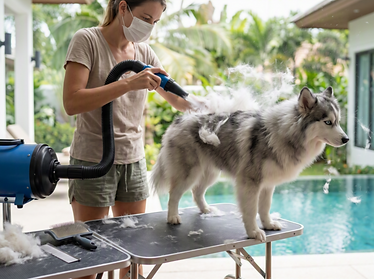
"Pomskies inherit their parent's "odorless" fur"
05
Grooming - The Odorless Fur
Both parent breeds are double-coated Spitz types, meaning a Pomsky will require similar grooming and will have an "odorless" fur just like their parents. They also undergo a "coat blow" about once a year where they lose their undercoat. Using a high-velocity force dryer and a slicker brush will help manage the fur. Grooming has never been so rewarding!
06
Energy & Exercise
While they have the spirit of a sled dog, they have the stamina of a toy breed. They need daily stimulation and physical activity, but they tire out much faster than a purebred Husky. A solid daily walk and some puzzle toys are usually enough to keep them satisfied. Their small size is also perfect if your playground space is limited or you live in the city. They're mainly indoor dogs and great watchdogs.

"Pomskies love morning walks and play daily"
What Makes Them Special?
The Pomsky offers a "best of both worlds" compromise. They possess the breathtaking, wild aesthetic of an Arctic sled dog without the demanding space and marathon-level exercise requirements that a 60-pound working dog demands. Their vibrant personality and hilarious behavior brings joy into your house, every day. Their nearly odorless fur keeps your home tidy, even in the smallest of condos. Being great watchdogs they'll protect you everywhere you go. And let's not forget, they are the ultimate "forever puppy" - a dog that retains its juvenile charm well into adulthood.
Why They Adapt Well to Thailand?
While a thick, double-coated Arctic crossbreed might seem counterintuitive for a tropical climate, the Pomsky actually holds a distinct advantage over a purebred Siberian Husky in places like Thailand.
Because of their significantly smaller physical mass, a Pomsky generates and traps less body heat than a full-sized Husky. While the midday sun might be too intense for them, they thrive with early morning walks and evening play sessions once the temperature drops. Their double coat also acts as an insulator; as long as the undercoat is properly maintained, it helps regulate their temperature, acting as a barrier between them and the harsh tropical sun.
